Certified vs. Notarised Translations – What’s the Difference?
Certified and notarised translation services are are often the key elements of international business, professional applications or legal cases and court proceedings.
Many people, however, do not fully understand the differences between the two services – a standard certified translation, and a notarisation. In today’s article, our language experts explain these differences in detail and answer when and why you might need either a certified, or a notarised, translation.
You can choose between a certified translation or a notarised translation to provide evidence that the document was accurately translated. Although both translation types serve the same purpose, they differ – in price, time needed to complete the service, certification level and complexity.
We’ll walk you through both to clarify when to use which one.
What Are Certified Translations?
An officially certified translation refers to a professional translation of documents completed by a registered agency or a qualified translator. A certified translation must include a signed declaration to back this. Typically, a translation is certified under one of the three conditions:
- When an official translator translates the document
- When a translation firm or translator certifies a document
- When the document is signed in the presence of a notary or a solicitor
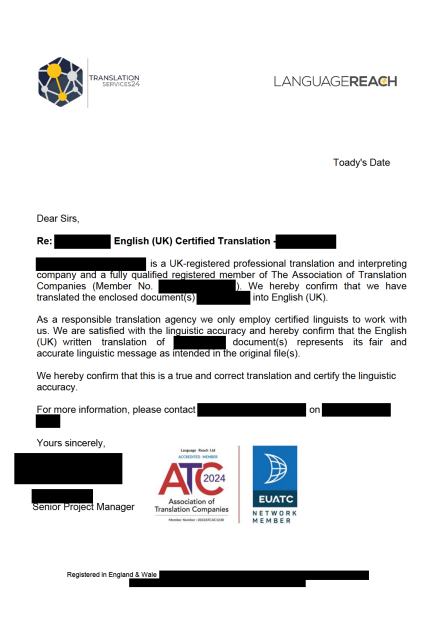
Certified Translation Example
Countries other than the United Kingdom appoint their official translators, who are referred to for certified translations. Generally, a country’s government selects these translators to adhere to translation quality standards.
For instance, the Ministry of Foreign Affairs appoints translators in Spain. They are responsible for including their unique seal for each translated document.
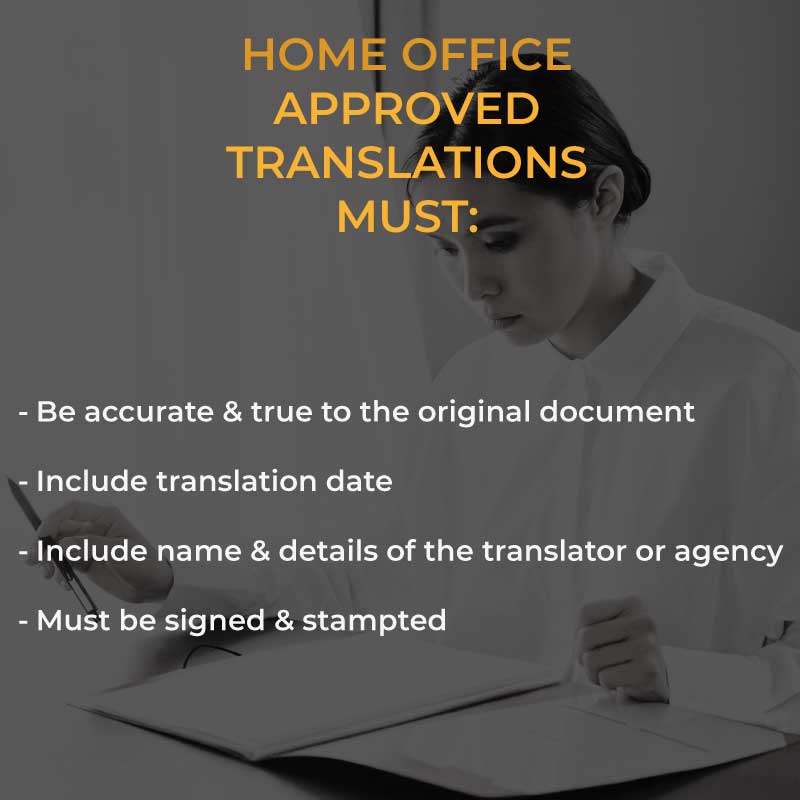
Although the UK doesn’t have government-appointed translators, it expects the translator to be qualified with a translation diploma to demonstrate their expertise in the field. The Home Office looks for the following information in the translation documents.
- The translation must be accurate and true to the original document
- It must include the translation date
- The name and contact details of the translator or translation agency
- The signature of the translator or representative of the translation company
Here in the UK, we have institutions that manage the translation industry to ensure the production of high-quality translations. These include the Association of Translation Companies (ATC) and the Chartered Institute of Linguists.
When to Get a Certified Translation?
A certified translation is required when submitting legal documents. For instance, you’d need one if you plan to immigrate to another country for example. Other common documents include the following.
- Marriage certificates
- Birth certificates
- Death certificates
- Court transcripts
- Business contracts
- Transcriptions
- Divorce decrees
- Driver’s license
- Service agreements
- Police verification background checks
What are Notarised Translations?
Where an official translator completes certified translations, notarised translations focus on adhering to official proceedings. A government-authorised notary is responsible for overseeing legal formalities.
So, anyone can give the translation because the notary only needs to acknowledge its accuracy by signing an affidavit. The translator must also sign a certificate statement before the notary, who will stamp and sign the translation.
However, because notaries aren’t multilingual, they’ll need help to check the translated document’s accuracy.
So, the purpose of signing the document is to certify that the translator vowed for it to be accurate. In other words, the signature and stamp certify the document, not the translation.
Also, a few more steps go into notarised translation if you’re getting one here in the United Kingdom. For instance, you’d need the approval of the Foreign Office if you want to use a document outside the UK.
A few countries may also require consular legislation along with the notarised translation. Fortunately, notaries can assist with both processes.
Because a notarised translation is certified by a government employee, it will be accepted outside the UK. Nonetheless, you can always ask the institution requesting the translation if you plan to use your translated document outside the country.
When to Get a Notarised Translation?
Notarised documents are generally used in educational institutes that require foreign degrees and diplomas. You might need a notarised translation service for the following documents.
- Transcripts
- Professional qualifications
- Degree certificates
- Other official documents
Certified Vs. Notarised Translations – What’s the Difference
The primary difference between the two types of translation is the presence of a notary. A notarised translation signifies that the related parties underwent an official procedure.
Most government institutions no longer require notarised translations. However, private institutions may have different processes and need one. You can always ask the relevant institution to know which translation they need.
If you are looking for a certified translation and notarisation service, you will be required to pay for the translation and the notary public’s fee.
Conversely, the fee for notarised translation is included in the translation company’s charges. The notary public generally charges a per-bundle fee.
It would help if you informed the translation service provider about the country you’ll use for either translation type. Because countries have different translation requirements, the final translation must adhere to the standards of each region.
What to Consider When Choosing a Translation Services Agency?
It’s best to conduct thorough research before picking a language translation services provider. The company will assign the work to a certified professional translator who specializes in the law domain; this is all you need.
Here are a few other factors to consider.
- Do check the agency’s pricing policy. The services should neither be extremely expensive nor cheap. Remember, extravagant services do not always indicate the best ones.
- Consider the company’s quality assurance policy. Of course, you cannot entrust your valuable translation documents to anyone. Ensure the company has professional linguists and quality review processes for high-quality translated documents.
- Skim through online reviews to check a company’s reputation in the industry. A look into its past work will inform you about the authenticity of its services.
Conclusion
Whether you need a certified or notarised translation, working with a reputable translation company is crucial.
Work with a company that will assign qualified translators to translate the source language to the target language keeping the tone, style, grammar, and writing system closest to the original.
Your notarised or certified translations must be accurate and conform to the legal standards of the organisation or institution that will receive your documents.
Find Out Which Certification Your Document Needs
Still not sure which type of certified translation you need? Use our free tool to get clear guidance on the certification your translation needs, based on your document type, destination country, and intended use.
About TS24
Translation Services 24 (TS24) is a professional London translation agency offering expert services in over 200 languages. We work with clients in all corporate and public industries and specialise in sector-specific linguistic solutions. With over a decade of industry experience, 15+ million words translated every year, and 100,000+ projects completed, TS24 is a leading provider of expert translation and interpretation services and an officially certified member of the ATC. Contact TS24 here.

Follow Translation Services 24 on Social Media