10 Common Problems That Can Cause a Certified Translation to Be Rejected
From missing professional certification, incorrect names or dates, and illegible documents – there are many reasons why your translation might be rejected by authorities.
Our professional translation specialists have more than 15 years’ experience handling certified document translations for immigration, legal, academic and other official purposes, so we’ve seen it all.
We know exactly how frustrating it can be when a document is rejected in an official application because of a simple mistake that could have been easily avoided.
At TS24, we help clients every day to amend, translate and professionally certify their documents which were translated elsewhere, and as a result of a simple mistake, were rejected by the requesting authority, whether the Home Office, UK Visas and Immigration (UKVI), a court, university or another organisation receiving official documents.
With a deep understanding of certification standards across all application types – from Visa applications, Court-submissions, and University Admissions, we prepared this guide to help you in avoiding costly mistakes and to save you time. Based on our experience in working with thousands of clients who required our help in amending their rejected translations, our certification experts explain some of the most common reasons why your translated documents might be rejected by authorities in the United Kingdom and abroad.
10 Reasons Why a Certified Translation Might Be Rejected
Based on our experience providing certified translations and helping thousands of clients each month whose translations were rejected by an authority, these are the 10 most common reasons why a certified translation may be rejected:
- The translation wasn’t professionally certified
- The statement of truth is missing
- Names, dates and document numbers don’t match
- Part of the original document was not translated
- There are errors in the translation
- The original document is difficult to read
- The certification type doesn’t match the authority’s requirements
- The document was self-translated or translated by AI
- Wrong language pair identified in the statement
- No hard-copy document submitted
1. The translation wasn’t professionally certified
The requirements for a certified translation depend on the organisation receiving your documents.
For example, current Home Office guidance for a number of immigration routes requires a fully certified translation from a professional translator or translation company that can be independently verified by the Home Office.
The translation must include specific certification details, including confirmation that it is accurate, the date, the translator’s or authorised official’s name and signature, and contact details.
Some other authorities may impose additional requirements, so applicants should always check the instructions for their specific application.
Depending on the requirements of the receiving organisation, certification may be provided by the translator or an authorised official of the translation company.
The certification should contain the information required by the relevant authority.
We regularly help clients who have obtained translations elsewhere and subsequently discovered that their translation did not meet the requirements of the organisation receiving their documents.
As an ATC-member, with a vast network of CIOL and ITI-registered translators, we do this by simply re-translating the original document and applying the appropriate certification type.
EXPERT’S TIP: Are you looking for a complete guide to certified translations? Read the TS24 comprehensive guide to certified translations here.
2. The required certification statement or declaration was missing
Different authorities use different terminology for translation certification.
A certified translation may need a declaration confirming that the translation is accurate, together with the date, translator’s or authorised official’s name and signature, and contact details.
Court proceedings can involve separate procedural requirements, including statements of truth, depending on the document and the applicable court rules. These should not be confused with the translator’s certification of accuracy.
3. Names, dates and document numbers don’t match
Each week our team works and helps hundreds of clients whose documents are refused during application process at the UKVI, Embassy submissions or court proceedings because of incorrect name spellings, wrong dates or page numbers not matching the original.
Ensuring that all names, dates, and numbers across all pages are accurately translated is absolutely crucial for ensuring that your documents are accepted by authorities.
4. Part of the original document was not translated
When submitting documents such as bank statements, letters, or birth certificates, it’s key that all key parts of the document are accurately translated and no important information is accidentally omitted.
From our experience, missed names, dates, and crucial information within the document, but often also omitting information that at first may appear insignificant, are some of the most common reasons why documents get rejected by the requesting authorities.
5. There are errors in the translation
A professional translation must be completely accurate and precise. Accuracy is essential.
A certified translation should faithfully reflect the content of the original document, including names, dates, numbers, addresses and other material details.
Often, we work with clients who translated their documents elsewhere, and upon submitting the translation for their official application, realised that it contains errors – causing it to be rejected by the authority.
6. The original document is difficult to read
Submitting documents with poor quality scans, blurred images or digital version that are difficult to read, and perhaps are even illegible in some parts, from our experience, is one of the main reasons why a document can be rejected during an official application.
When obtaining a certified translation, ensure that your original documents are clear, easy to read and clearly show all content within them.
7. The certification type doesn’t match authority’s requirements
Before obtaining your translation, it’s important to confirm directly with the requesting authority which specific certification type/level they require for your application.
Generally, a standard certification is sufficient in the United Kingdom, however, the authorities may also require your translation to include a statement of truth, notarisation or even an apostille.
Certification, notarisation and legalisation/apostille are different processes. Whether you need one or more of them depends on the organisation requesting the document and, for documents used overseas, the requirements of the destination country.
Daily, we help clients whose translations were rejected by authorities because they obtained the incorrect certification type.
EXPERT’S TIP: Learn the difference between a certified and notarised translations in our expert’s article here!
8. The document was self or machine-translated
We often help clients who are bilingual and translated their documents or certificates themselves or used online tools to do so.
A self-translation or machine-generated translation may not satisfy an authority’s certification requirements where the authority requires a certified translation from a professional translator or translation company.
Generally, certified translations must be completed, in full, by an accredited human translator, who professionally confirms the accuracy of their translation.
9. Wrong language pair identified in the statement
Certified translations come with attached signed statement, confirming that the translation is accurate and compete.
The certificate of translation accuracy, and/or the statement of truth signed by the translator, confirm details of the documents, which includes the source and target languages.
An incorrect language pair in the certification statement can create an inconsistency between the declaration and the actual translation. The receiving authority may query the document or decide that the certification does not satisfy its requirements.
For example, if a document was translated from French into English but the certification statement incorrectly states, “German into English”, the inconsistency could cause the receiving organisation to query the translation or determine that the certification does not meet its requirements.
10. No hard-copy document submitted
A certified translation can be delivered digitally, and the hard copy with a ‘wet signature’ by post. Generally, if your application takes place online, the digital certified version is sufficient. However, if you also need to submit your documents in-person, you may need the hard copy.
We help many clients who wrongly believe that once they receive the digital version of their translation, they can simply print out the document at home, and then submit it in person.
However, this isn’t the case. The required format can depend on how and where the documents must be submitted.
Some organisations may accept a digitally certified translation, while others may request or require an original paper document or specific form of signature. Do not assume that printing a digitally supplied translation yourself will create an equivalent certified original.
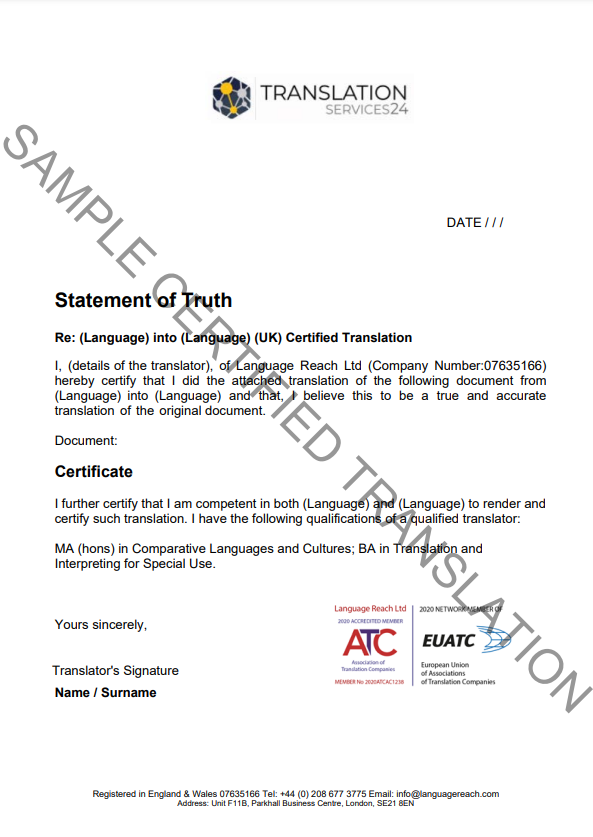
Certificate of Accuracy – Example
What does UKVI currently require?
For applications where the Home Office requires a certified translation, current Home Office guidance says the translation must be provided by a professional translator or translation company that can be independently verified by the Home Office.
It must include confirmation that it is an accurate translation, the date, the full name and signature of the translator or an authorised official, and contact details. Requirements can vary by application route, so applicants should check the current guidance for their specific application.
How can you reduce the risk of your translation being rejected?
There is no single certification format that applies to every UK authority or every type of application. The requirements of UKVI, courts, universities, DVLA, passport authorities, overseas embassies and other organisations can differ. Always check the current instructions of the organisation receiving the document.
There, however, are a few simple things you can do before sending a document for translation.
First, check what the organisation receiving the document actually requires. Don’t rely solely on the phrase “certified translation”, as the requirements can differ depending on the application.
Then make sure you send the complete and correct version of the document. A clear scan or photograph can make the translator’s job considerably easier.
It’s also worth telling the translator or agency representative where the document will be submitted. At TS24, we advise hundreds of clients every week in regard to the certification they may require for their particular application. However, this information must always be provided and confirmed directly by the receiving authority – whether it’s the Home Office, UKVI, Government Bodies or University.
If you’re applying to a particular authority, that information may be relevant when determining the appropriate certification.
When you receive the finished translation, compare the important details with the original. Check your name, date of birth, document numbers, dates and addresses carefully.
And if something doesn’t look right, ask about it before submitting the document.
Find Out Which Certification Your Document Needs
Still not sure which type of certified translation you need? Use our free tool to get clear guidance on the certification your translation needs, based on your document type, destination country, and intended use.
About TS24
Translation Services 24 (TS24) is a professional London translation agency offering expert services in over 200 languages. We work with clients in all corporate and public industries and specialise in sector-specific linguistic solutions. With over a decade of industry experience, 15+ million words translated every year, and 100,000+ projects completed, TS24 is a leading provider of expert translation and interpretation services and an officially certified member of the ATC. Contact TS24 here.
Follow Translation Services 24 on Social Media