AI Translation vs Human Translation: Which Is Better in 2026?
Last reviewed: October 2026
AI and machine translations are today faster and cheaper than ever, but in high-risk, legal, medical, customer-facing, and brand-sensitive content, human expertise still determines quality and accuracy.
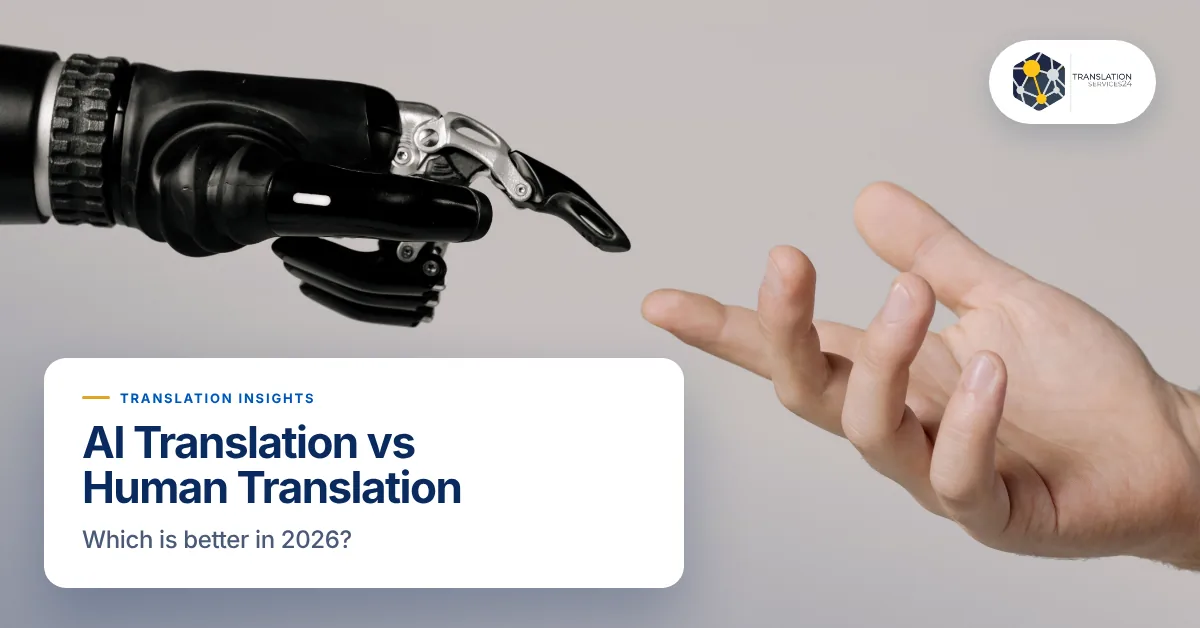
Today, we’re taking a closer look at the differences between human and AI translation services. Whether you are considering automated translation tools or evaluating a professional translation agency, this guide explains where AI translations perform well, where human expertise remains essential, and how modern translation workflows combine both.
At TS24, we regularly work with clients who need AI translation, human translation, or a mix of both, known as machine translation post-editing (MTPE). Since 2011, we’ve translated everything from multilingual websites and software interfaces to legal, financial and certified documents, so we see first-hand where each approach works and where it doesn’t. In this guide, we share what we tell our own clients when they ask which option is right for them.
The honest answer is rarely “one or the other”. It depends on what the content is, who will read it, and what happens if it’s wrong.
What Is AI Translation?
AI translation uses artificial intelligence to automatically translate text from one language to another. Most tools today are built on neural machine translation (NMT), and a growing number also use large language models (LLMs).
Unlike older rule-based and statistical systems, which tended to produce stiff, literal output, modern AI translation tools are trained on huge amounts of multilingual text. This allows them to recognise patterns, context, sentence structure, and common phrasing across languages – which is why AI-based translation platforms now produce translations that read far more naturally than they did a decade ago.
In practice, AI translation is built for speed and scale, making it useful for translating large volumes of content quickly.
However, while the technology has improved significantly, AI still works on probability – predicting the most likely translation – rather than a genuine understanding of culture or intent. That’s why context, tone, nuance, and industry-specific terminology can still cause problems in professional translation projects.
AI vs Machine Translation
Although the terms ‘AI translation’ and ‘machine translation‘ are often used interchangeably, there are important differences between the two.
Machine translation is the broader category: any software that automatically translates text between languages. Earlier machine translation systems relied heavily on fixed rules, dictionaries, and statistical models, which often resulted in rigid, literal translations that lacked natural flow.
Modern AI translation is a more advanced form of machine translation that uses neural networks and large language models to handle context, sentence structure, and natural language patterns far better. This is why today’s AI-powered tools can often produce translations that sound more fluent and human than older systems.
That said, fluency does not always equal accuracy.
In our experience translating SaaS onboarding flows, AI often handles straightforward UI strings accurately, but struggles with tone consistency across user journeys. A button label or navigation element may translate perfectly well in isolation, yet the wider customer experience can feel inconsistent once tone, brand voice, and contextual meaning are taken into account.
This is one of the biggest differences between automated translation and professional human localisation. AI can process language at scale, but it still lacks a genuine understanding of user intent, cultural nuance, and brand communication strategy.
What Is Human Translation?
Human translation involves professional linguists translating content themselves, with a focus on meaning, context, tone, and cultural accuracy rather than simple word-for-word translation.
Professional translation agencies typically work with native translators who translate into their first language, helping ensure the final content sounds natural and appropriate for local audiences.
This is particularly important in localisation projects, where content must be adapted to suit cultural expectations, regional language differences, and user behaviour – not just translated literally.
There is also an important difference between being bilingual and being a professional translator. While a bilingual speaker may understand two languages, professional translators are trained to handle industry terminology, writing style, localisation, accuracy, and linguistic nuance at a much higher level.
Many professional translators also specialise in specific sectors such as legal, medical, technical, or marketing translation, where subject-matter expertise is essential.
At TS24, every translator and interpreter we work with is accredited by a recognised professional body such as the Chartered Institute of Linguists (CIOL), the Institute of Translation and Interpreting (ITI) or the American Translators Association (ATA), and has at least five years’ experience translating within their specialist field. We match each project to a linguist based on the subject matter, industry, language pair and any certification requirements.
For example, every legal, medical or marketing translation at TS24 goes through a strict translator review and independent proofreading before delivery. This is what protects accuracy, compliance, a consistent brand voice and cultural suitability.
The Biggest Strengths of AI Translation
1. Speed and scalability
This is where AI is unbeatable. A machine translation engine can process thousands of words in seconds, so large, repetitive jobs – product catalogues, support articles, internal knowledge bases, user reviews – can be turned around in a fraction of the time a fully manual process would take. For businesses publishing content in several languages at once, that speed changes what’s realistically possible.
2. Lower costs for high-volume, low-risk content
For high-volume or low-risk informational content, AI-assisted workflows can significantly reduce translation and localisation costs. The saving comes from letting the machine produce the first draft, so human time is spent where it matters most: checking, correcting and refining rather than translating every sentence from scratch.
3. Consistency on repetitive text
AI is very good at short, predictable strings that repeat across a project, such as menu items, product specifications or standard technical phrases. In our experience, AI performs well for repetitive technical strings but still requires expert review for customer-facing marketing content.
Where AI Translation Falls Short
1. Legal and certification compliance
Contracts, certificates, court filings and medical documents leave no room for “almost right”. A mistranslated legal clause can alter contractual meaning and create liability – and an AI tool can’t be held accountable for it.
The same applies to official documents. A certified translation needs a translator or translation company to confirm in writing that it is accurate, and to sign and date it. For UK immigration applications, these requirements are set out in paragraph 39B of the Immigration Rules. Raw machine output can’t meet that standard on its own, because a named professional has to take responsibility for the translation.
This is why legal work at TS24 is handled by certified, native legal translators. For example, for international law firm Osborne Clarke we’ve translated over 150,000 words across several projects, including legal documents, court documents, medical reports and witness statements, with a dedicated account manager and translation team. You can read more in our Osborne Clarke case study.
2. Cultural context and brand tone
AI translates what’s written, not what’s meant. Humour, idioms, slogans, and the overall tone of a brand often don’t survive a literal translation – and the result can sound flat, odd, or simply wrong to a native reader. For campaigns and slogans in particular, the job is often closer to transcreation than translation.
3. Industry-specific terminology
AI tools may translate the same technical term in two or three different ways within a single document, or choose a general-language word where an industry term is required. In regulated industries, terminology consistency is not optional – which is why professional workflows check terms against an approved glossary rather than leaving it to the engine.
On our long-term corporate accounts, we agree tone of voice and terminology with each client at the start, then build and maintain translation memories so the same wording is used consistently across every market, channel and project. That kind of consistency is very hard to achieve by running content through an AI tool on its own.
EXPERT’S TIP: Learn how glossaries and translation memories keep terminology consistent across projects in our guide to translation memory vs glossary.
4. Confidentiality
It’s easy to forget that pasting a document into a free online tool means sending it to a third party. Each tool has its own terms – for example, DeepL’s privacy policy states that text submitted to its free translator may be processed to train and improve its models, while its paid Pro service does not use texts for this purpose. Before uploading contracts, financial records or anything containing personal data, it’s worth checking exactly where that content goes. For sensitive material, a confidential translation service with a clear data-handling process is the safer route. TS24 is Cyber Essentials accredited and provides a secure online client portal for uploading and receiving documents.
AI vs Human Translation, Side by Side
| AI Translation | Human Translation | |
|---|---|---|
| Speed | Near-instant, even for large volumes | Slower; depends on volume, subject and language pair |
| Cost | Low per word, especially at scale | Higher, reflecting specialist time and review |
| Accuracy | Often good on simple text; errors can be fluent and hard to spot | High, with review and proofreading built in |
| Cultural nuance | Limited; tends towards literal meaning | Strong; adapted for the local audience |
| SEO localisation | Translates keywords literally, which may not match what local users search for | Can adapt keywords, titles and metadata to local search behaviour |
| Legal & certified use | Not suitable on its own | Suitable; can be certified by the translator or agency |
| Brand voice | Inconsistent across longer content | Consistent, guided by style guides and glossaries |
| Scalability | Excellent | Limited by translator capacity |
| Confidentiality | Depends on the tool’s terms; free tools may retain or reuse submitted text | Controlled through the agency’s own data-handling and confidentiality processes |
When Is AI Translation the Right Choice?
AI translation makes sense when speed matters more than polish, and when a small error wouldn’t cause real harm. Typical examples include:
- Internal documents – emails, notes and reference material that only your team will read.
- Large catalogues – thousands of product descriptions or specifications, ideally with human post-editing on your best-selling or most visible items.
- Supporting documents – getting the gist of a long document to decide whether it needs a full professional translation.
Even here, a quick human check is worth it for anything that will be published.
When Is Human Translation Essential?
If the content carries legal, medical, financial or reputational risk, a professional translator should be involved. That includes:
- Legal documents – contracts, court documents and terms and conditions, where one word can change the meaning.
- Medical records – where errors can affect patient safety, treatment or insurance claims.
- Marketing campaigns – where tone, humour and cultural fit decide whether a message lands.
- Website and digital localisation – where you need content that reads naturally, ranks locally and reflects your brand.
- Certified translations – for immigration, courts, universities and other official purposes, which require a professional’s signed confirmation of accuracy.
On websites specifically, it’s worth knowing that Google’s spam policies list automated translation among the techniques that can count as scaled content abuse when it’s used to mass-produce pages mainly to manipulate rankings rather than help users. Translation itself isn’t the problem – publishing large amounts of unreviewed, low-value pages is.
EXPERT’S TIP: Planning a multilingual website? Read our guide to translating and localising your website first.
The Rise of AI-Assisted Human Translation
In reality, most professional translation projects today aren’t purely AI or purely human. When scoping a project, our senior translation managers advise clients on whether the content is best suited to human translation, machine translation with post-editing (MTPE), or a combination of the two – based on how the content will be used, its level of risk, the deadline and the budget. Where AI is the right fit, our AI-assisted translation workflow combines both, in five stages:
- AI-assisted drafting – the source text is run through an AI translation engine to produce a first draft.
- Human editing – a professional, accredited native translator edits the draft line by line against the original, correcting meaning, accuracy and style. This is what’s known as machine translation post-editing (MTPE).
- Terminology QA – key terms are checked against the client’s glossary or approved terminology, so the same term is translated the same way every time.
- Localisation review – the text is reviewed for the target market: tone, cultural references, formats, and anything that reads awkwardly to a local audience.
- Final proofreading – an independent proofreader carries out a last check before delivery.
The machine does the heavy lifting on volume; people stay responsible for the quality. You can read more about how projects move through each stage on our translation process page.
The future of translation is not AI versus humans – it is expert human translators using AI responsibly.
Frequently Asked Questions
Can an AI translation be certified?
Not on its own. A certified translation requires a translator or translation company to confirm that the translation is accurate, and to sign and date it. A professional translator can review and correct an AI draft and then certify the final version – but at that point, they are taking full responsibility for the translation. Always check the specific requirements with the authority receiving your documents.
Is it safe to put confidential documents into free AI translation tools?
It depends on the tool’s terms, and many people never read them. Some free services state that submitted text may be stored or used to improve their models. For contracts, financial records, medical information or anything containing personal data, use a paid service with clear data-handling terms or a professional agency.
What is machine translation post-editing (MTPE)?
MTPE is the process of a professional translator reviewing and correcting machine-translated text. The international standard ISO 18587 sets out requirements for full, human post-editing of machine translation output and for post-editors’ competences. At TS24, MTPE is carried out by native, accredited translators who specialise in the relevant subject area. Learn more about our MTPE services.
Is AI translation good enough for my website?
For low-traffic help pages, it can be a reasonable starting point, provided someone reviews it. For your homepage, product pages, landing pages and anything that needs to rank or convert, we’d recommend human-edited translation and localisation – including local keyword research, rather than literally translated keywords.
Final Verdict: AI vs Human Translation
AI is excellent for speed and scale. Humans remain essential for nuance, liability, trust, branding and localisation.
The question to ask isn’t “AI or human?” but “what happens if this translation is wrong?” If the answer is “not much”, AI may well be enough. If the answer involves a rejected application, a legal dispute, a patient, or your brand’s reputation, you need a professional translator – ideally one who knows how to use AI to work faster, without cutting corners.
Not sure which approach suits your project? Talk to our team or get a free quote – we’ll recommend the right mix of AI and human expertise for your content, budget and deadline.
About the reviewer
Nello Attianese is a Senior Translation Manager at TS24. He joined the company in 2014 and has spent more than a decade managing business and corporate translation projects for organisations such as DLA Piper, Oracle and SailPoint. Part of his role is advising clients on whether a project is best suited to human translation, MTPE or a combination of the two. Nello holds an MA Hons in Comparative Languages and Linguistics and a BA in Translation and Specialised Languages, and is fluent in Italian, German, French and English.
About TS24
Translation Services 24 (TS24) is a professional London translation agency offering expert services in over 200 languages. We work with clients in all corporate and public industries and specialise in sector-specific linguistic solutions. With over a decade of industry experience, 15+ million words translated every year, and 100,000+ projects completed, TS24 is a leading provider of expert translation and interpretation services and an officially accredited member of the ATC (2026ATCAC1238). Contact TS24 here.
Follow Translation Services 24 on Social Media