Do You Need a Digital or Hard Copy of Your Certified Translation? UK and International Rules Explained
Last reviewed: November 2026
“Can I just upload the PDF, or do I need the copy with the real signature on it?” It’s one of the questions our certified translations team hears most, and the answer depends far more on who is receiving the translation than on the translation itself.
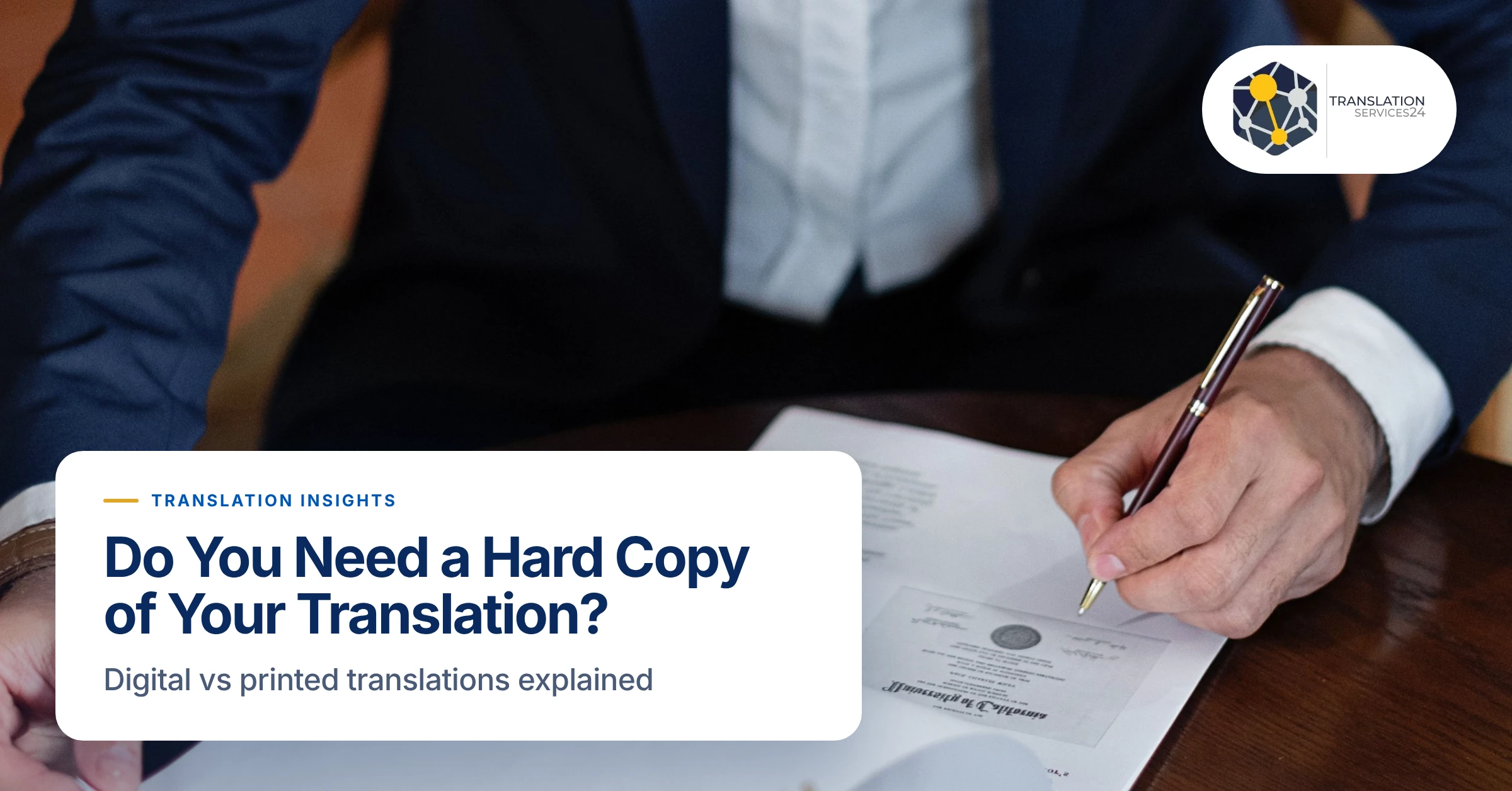
The short answer: a digital certified translation (a PDF sent by email) is usually accepted for online submissions, including most UK visa applications, but the receiving authority can still ask to see a hard copy. If your application or appointment takes place in person, if the authority asks for original documents, if the translation is going to be notarised and given a paper apostille, or if the country it’s going to still works on paper, you’ll need a hard copy signed in ink.
Because of that, our advice is simple: keep a signed hard copy, just to be safe. At TS24, the hard copy comes with your PDF at no extra charge.
Below, we set out what we tell clients before they order, for the UK and for some of the countries we send translations to most often.
Key points
- Both versions carry the same certificate of accuracy. The difference is how they’re signed: an image or electronic signature on a PDF, or ink and a stamp on paper.
- Online submissions, including most UK visa applications, usually accept a certified PDF, but the authority may still ask for the hard copy later.
- If any part of your application takes place in person, bring the signed hard copy.
- HM Passport Office asks for original documents for a first adult passport, so we recommend the signed hard copy.
- A paper apostille is physically attached to a paper document. The UK’s e-Apostille is the digital alternative, but not every country accepts it.
- Abroad, rules vary widely: Spain now allows sworn translations signed electronically, while Italian sworn translations are still sworn in person at court.
- Our recommendation is to always have the hard copy to hand. TS24 includes it at no extra charge.
What’s the Difference Between a Digital and a Hard Copy?
The translation is the same in both. A certified translation from TS24 comes with a signed, stamped and dated certificate of accuracy, the translator’s or our representative’s details, and the language pair. What changes is the format.
A digital copy is a PDF sent by email. The signature and stamp are applied to the file, usually as an image, although some countries use a cryptographic electronic signature that can be checked by software.
A hard copy is printed, signed in ink (the “wet signature”) and stamped, then posted or collected. It’s the version most authorities treat as the original.
Neither is more “official” in itself. The question is always which format the person receiving it will accept, and since that can change partway through an application, having both covers you either way.
When a Digital Copy Is Usually Fine in the UK
For UK immigration, translation requirements are set out in paragraph 39B of the Immigration Rules. You need to provide the original-language document and a full translation that the Home Office can independently verify. The translation must be dated, confirm it’s accurate, and carry the translator’s (or company official’s) name, signature and contact details. Leave to remain and settlement applications also need the translator’s credentials. The rules say nothing about the translation having to be on paper.
In practice, the application route decides it. GOV.UK tells visa applicants to scan and upload their supporting documents, and inside the UK you either upload to UKVCAS yourself or have your documents scanned at your appointment. So for UKVI visa applications, the certified PDF is usually what gets submitted.
The same is usually true of universities, employers, banks and other organisations that take documents through an online portal.
“Usually” is the important word, though. An online submission doesn’t guarantee the PDF will be the end of it. Decision-makers can ask to see original documents later, and if your scans are rejected or something goes wrong with the upload, you may be asked to bring your documents to an appointment. Having the signed hard copy ready means you won’t need to reorder and wait.
When You’ll Need a Hard Copy in the UK
In-person applications and appointments. If you’re handing documents over in person, at a consulate, embassy, register office, bank, solicitor’s office or court, take the signed hard copy. A PDF on your phone or a home printout may not be accepted at the desk.
Passport applications. For a first adult passport, GOV.UK says you must send original documents and that photocopies are not accepted. That applies even when you apply online. Because the foreign birth certificate or naturalisation document has to be posted anyway, we recommend sending our signed and stamped hard copy of the translation with it, rather than a home-printed PDF.
Notarisation and paper apostilles. If your translation is going abroad and needs a notarised translation followed by a paper apostille, the whole bundle is physical. The notary signs and seals paper, and the FCDO attaches the apostille certificate to it.
When you’re told to bring or send originals. Some solicitors, registrars, courts and overseas consulates will ask for the original translation. If the instructions mention “originals”, you’ll need the hard copy.
EXPERT’S TIP: Not sure whether you need an apostille as well as a certified translation? Read our guide to apostille vs certified translation before you order.
UK Requirements at a Glance
| Where it’s going | Digital PDF | Signed hard copy | Why |
|---|---|---|---|
| Any in-person application or appointment | Not recommended | Yes | Officials usually expect to see the signed original |
| UK visa, settlement or citizenship (UKVI) | Usually accepted for upload | Recommended to keep | Documents are scanned and uploaded, but originals can be requested |
| First adult UK passport (HMPO) | Not recommended | Yes | Original documents are sent by post; photocopies are not accepted |
| Universities, employers, online portals | Usually accepted | Recommended to keep | Documents are uploaded, but some ask for originals at a later stage |
| Notarisation + paper apostille | No | Yes | The notary’s seal and the apostille are attached to paper |
| Notarisation + e-Apostille | Yes, if electronically signed by a UK notary | Not needed for the e-Apostille itself | Only if the receiving country accepts e-Apostilles |
| Solicitors, courts, registrars, consulates | Sometimes | Usually | Varies; follow their written instructions |
Apostilles: Paper or e-Apostille?
The UK Legalisation Office issues apostilles in two forms, according to GOV.UK:
| Paper apostille | e-Apostille | |
|---|---|---|
| Fee | £45 per document, plus postage | £35 per document |
| Processing time | Up to 25 working days, plus postage | Up to 2 working days |
| What you submit | The signed paper document | A PDF electronically signed by a UK notary or solicitor |
| Limits | Accepted by Apostille Convention countries | Not every country accepts it, and some documents (such as GRO birth, marriage and death certificates) aren’t eligible |
So a notarised translation can be apostilled digitally, provided the notary signs the PDF electronically. Whether that’s a good idea depends entirely on the destination, and GOV.UK advises asking the organisation receiving the document which version it needs before you apply. If there’s any doubt, the paper route is the safer choice.
What Other Countries Expect
Outside the UK, the starting point is often different. Many European countries use sworn translators appointed by a ministry or court, and only their translations count as official. Here’s how some of the countries we regularly translate for handle the digital question:
| Country | Who certifies | Digital accepted? |
|---|---|---|
| United States (USCIS) | The translator certifies the translation is complete and accurate and that they’re competent to translate (8 CFR 103.2(b)(3)). Notarisation isn’t required. | Generally yes. USCIS accepts copies of evidence and online filings are uploaded, although originals can be requested, for example at an interview. |
| Canada (IRCC) | A certified translator’s stamp, or an affidavit from the person who translated it | Yes for online applications. IRCC asks for the translation to be uploaded, with the translator’s stamp on a copy of the original. |
| Australia | NAATI-certified translators for translations made in Australia | Yes. NAATI’s digital stamp, introduced in March 2023, has a QR code that can be scanned to verify the translator. |
| Spain | Sworn translators (traductores jurados) appointed by the Ministry of Foreign Affairs | Yes, since March 2025. Order AUC/213/2025 lets sworn translators sign with a qualified electronic signature. Ink and stamp remain valid. |
| Italy | The translator swears the translation in person at an Italian court (asseverazione) | Generally paper. Court guidance requires physical revenue stamps (marche da bollo) on the sworn translation. |
| Belgium | Sworn translators on the national register | Both. The Belgian Justice Ministry allows a scanned signature on the electronic version, but a paper version must be signed by hand. |
A UK certified translation isn’t automatically accepted in a sworn-translation country. Where one is required, we arrange it through a registered sworn translator in that country, and their rules on digital or paper delivery apply.
Quick Decision Guide
→ Digital PDF is usually accepted, but keep the hard copy in case it’s requested
→ Signed hard copy
→ Hard copy for a paper apostille, or an electronically signed PDF for an e-Apostille if the destination accepts it
→ Follow that country’s rules (for example, electronic signature accepted in Spain, paper in Italy)
Free Certification Checker:
Find Out Which Certification Your Documents Need
Still not sure which type of certified translation you need for your documents? Use our free tool to get clear guidance on the certification your translation needs, based on your document type, destination country, and intended use.
Frequently Asked Questions
Can I print the PDF myself and use that as the hard copy?
Only where the receiving organisation just needs to read it. A printout isn’t signed in ink, so an authority that asks for originals, or an official checking documents in person, may treat it as a copy and turn it away. That’s why we recommend the signed hard copy.
Do I need a hard copy for a UK visa application?
For the upload itself, usually not. UK visa applicants scan and upload their supporting documents, so the certified PDF is normally what gets submitted. But originals can be requested later, and you may be asked to bring documents to an appointment, so we recommend keeping the signed hard copy safe until you have a decision.
Can a digital certified translation be apostilled?
Only through the e-Apostille service, and only once a UK notary or solicitor has signed the PDF electronically. Check first that the destination country accepts e-Apostilles. If it doesn’t, you’ll need the paper route.
Can I get both a PDF and a hard copy?
Yes, and we recommend it. Every TS24 certified translation is emailed as a PDF, and the signed, stamped and dated hard copy is included at no extra charge. We can post it to you or arrange collection from our London office.
Check Before You Order
A certified translation can be perfectly accurate and still be turned away because it arrived in the wrong format. The application guidance or the receiving authority will usually tell you whether they need originals, an apostille or a sworn translation. And if you’re unsure, the hard copy is the safe option: it costs nothing extra with us, and it saves you from reordering if you’re asked for it later.
If you’d like us to check for you, contact our certified translations team or get a free quote. Tell us where the translation is going, and we’ll recommend the right format before we start. Requirements change, so always confirm the final details with the authority receiving your documents.
About TS24
Translation Services 24 (TS24) is a professional London translation agency offering expert services in over 200 languages. We work with clients in all corporate and public industries and specialise in sector-specific linguistic solutions. With over a decade of industry experience, 15+ million words translated every year, and 100,000+ projects completed, TS24 is a leading provider of expert translation and interpretation services and an officially accredited member of the ATC (2026ATCAC1238). Contact TS24 here.
Follow Translation Services 24 on Social Media