
Apostille vs Certified Translation: What We Tell Clients Who Ask
It’s perhaps one of the most common calls our certified translations team gets from clients: “I’ve had my document translated and certified – so why is the authority still asking for an apostille?”
The short answer is that a certified translation and an apostille are two completely different services that serve different purposes, and in many cases, you need both.
A certified translation is accompanied by a statement or certification confirming that the translation is a true and accurate translation of the original, in accordance with the requirements of the receiving authority.
An apostille authenticates the origin of a public document by confirming the signature’s authenticity, the capacity in which the signatory acted, and, where applicable, the identity of the seal or stamp. It does not certify the truth or accuracy of the document’s contents.
One is about language. The other is about authentication.
We get asked to untangle this most weeks, usually by someone with a deadline already looming – a university admissions office abroad, a foreign notary, an overseas employer. So here’s what we actually tell clients, based on what we see go right (and wrong) with these applications.
What Does ‘Certified Translation’ Actually Mean?
A certified document translation is a translation completed by a professional translator or a registered translation agency, accompanied by a signed and dated statement confirming it’s a true and accurate translation of the original document. In the UK, this statement – sometimes called a “certificate of accuracy” – is what makes the translation acceptable to UK authorities such as the Home Office, HM Courts, universities and most government bodies. It’s, however, important to remember that UK authorities may have their own requirements for each application, so we always advise checking these directly with the requesting authority.
For the vast majority of applications we translate – visa applications, academic transcripts, employment contracts, marriage certificates for use within the UK – a certified translation on its own is enough. No notary, no apostille, no extra steps.
EXPERT’S TIP: We’ve covered this in more depth in our guide to certified translation services.
What About an ‘Apostille’?
An apostille is a certificate issued by the competent authority (in the UK, generally the FCDO Legalisation Office) that authenticates the origin of a public document by verifying the relevant signature, capacity and, where applicable, seal or stamp. It’s recognised under the 1961 Hague Convention, which currently covers around 130 member countries, so if you’re sending a document to a country that’s signed up to the Convention, an apostille is generally all the authentication you need. If the destination country hasn’t signed the Convention, you may need full embassy legalisation instead, which is a longer process.
Crucially, it’s important to bear in mind that the Legalisation Office isn’t checking whether your translation is accurate.
The Legalisation Office checks the relevant signature, seal or stamp against the records available to it. Depending on the document, this may relate to a notary, solicitor or another recognised public official. There is no universal rule that every foreign-use translation must be notarised and then apostilled. The route depends on the document, the country, the receiving authority and the type of authentication requested.
The Important Step People Usually Miss: Notarisation
A translation certificate is not automatically eligible for apostille simply because it has been signed by a translator or translation agency. Depending on the receiving authority and the legalisation route, the translation may need to be certified or notarised by a person whose signature the Legalisation Office can authenticate.
To get a translation into a state where it can be apostilled, it normally needs to be notarised first: a UK notary public witnesses the translator’s signature (or the agency representative’s) and adds their own seal, which is on file with the Legalisation Office. A notarised translation service means that the apostille authenticates the notary’s signature, not the translator’s directly.
In practice, that means the real sequence for an apostille is usually:
- Document translated and certified by a qualified translator
- Translation notarised by a UK notary public
- Notarised translation submitted for an apostille
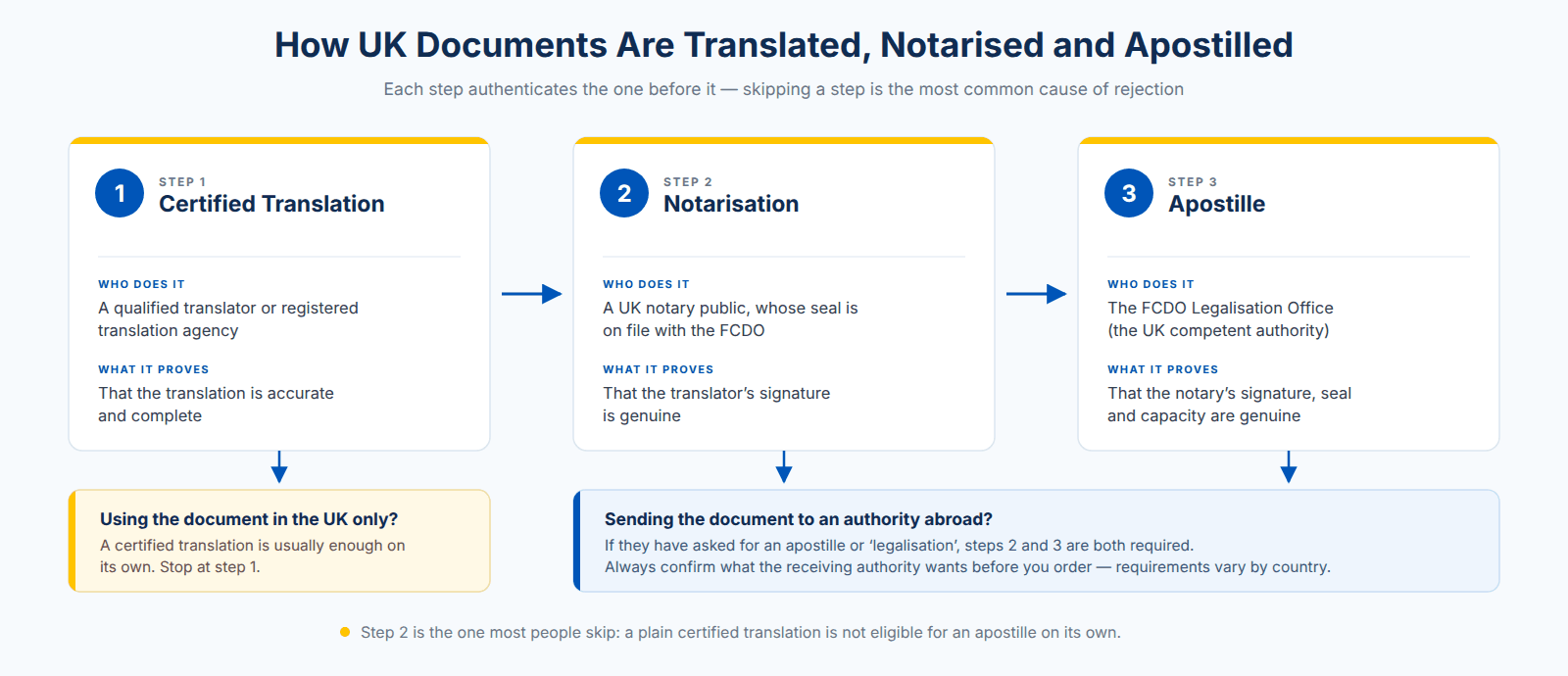
Skipping step 2 is the single most common reason we see applications bounced back or delayed – someone sends off a plain certified translation expecting an apostille, and it simply isn’t eligible.
EXPERT’S TIP: We’ve prepared an expert guide to notarised translations here.
Certified Translation vs Apostille, Side by Side
| Certified Translation | Apostille | |
|---|---|---|
| What it verifies | That the translation is accurate and complete | That a signature, stamp or seal on a document is genuine |
| Who issues it | A qualified translator or translation agency | The UK Legalisation Office (FCDO) |
| Typically needed for | UK Home Office, courts, universities, most domestic official use | Documents being sent to a country that requires formal authentication |
| Can it stand alone? | Yes, for most UK uses and applications | Only alongside an eligible, usually notarised, document |
| Extra step required? | None, usually | Often requires notarisation first |
What It Costs and How Long It Takes
Apostille fees and turnaround times are set by the FCDO and do change, so it’s always worth checking gov.uk’s current guidance directly before you budget for one. At TS24, the complete bundle – certified translation, notarisation, and an apostille starts around £220 and takes 10-12 working days combined to complete the whole process. The price and turnaround time typically depend on the required languages, the document type, and the total word count of your documents.
So, Which One Do You Need?
A rough rule of thumb we give clients:
- Using the document only in the UK? A certified translation is almost always enough on its own.
- Sending the document to an authority abroad, and they’ve specifically asked for an apostille or “legalisation”? You’ll likely need the translation notarised, then apostilled.
- Not sure what the receiving authority wants? Ask them directly before you order anything – it’s the one question that saves the most time and money. We’d always rather a client checks first than pays twice.
At TS24, we handle around 15-20 apostille and translation requests each week, helping clients prepare UK documents for use overseas where legalisation, an apostille and/or a certified translation is required by the receiving authority. Most frequently, we cover documents such as birth, marriage, and death certificates, police and criminal-record certificates, court documents, academic qualifications, and other official records for countries including France, Poland, Spain, Italy, and Germany.
Free Certification Checker:
Find Out Which Certification Your Documents Need
Still not sure which type of certified translation you need for your documents? Use our free tool to get clear guidance on the certification your translation needs, based on your document type, destination country, and intended use.
Frequently Asked Questions
Does every certified translation need an apostille?
No. Most certified translations used within the UK do not need one. An apostille is only relevant when a foreign authority specifically requires your UK document to be authenticated for use abroad. The specific certification requirements for your translated documents must always be checked directly with the receiving authority.
Can TS24 arrange the translation + notarisation + apostille package?
Yes, TS24 can arrange the whole package. We offer and coordinate the full process, including translation, notarisation and apostille.
Will a mistake in the notarisation stage delay my apostille?
Yes – the Legalisation Office checks the notary’s or solicitor’s signature against its own records, so if there’s any inconsistency, the application can be rejected or delayed.
Get It Right the First Time
Apostille rules are precise, and the FCDO won’t refund a rejected application. If you’re not sure whether you need a certified translation, a notarised translation, or a full apostille, talk to our certified translations team before you order – we deal with this most weeks and would rather answer the question up front than have you pay for the wrong service. We also always advise you to check your specific certification requirements directly with the receiving authority, as they can confirm whether a standard certified translation, notarisation, or an apostille is required.
About TS24
Translation Services 24 (TS24) is a professional London translation agency offering expert services in over 200 languages. We work with clients in all corporate and public industries and specialise in sector-specific linguistic solutions. With over a decade of industry experience, 15+ million words translated every year, and 100,000+ projects completed, TS24 is a leading provider of expert translation and interpretation services and an officially certified member of the ATC. Contact TS24 here.

Follow Translation Services 24 on Social Media